The OECD has just tested 760,000 15-year-old students across 91 countries, and the heaviest AI users know the least, with daily users showing roughly 18 months less learning development than their peers who never touch it.
These kids will start entering the workforce around 2031, but this same habit of outsourcing thinking to AI is already spreading through enterprises today. We are caught in a pincer movement, with AI eroding how humans learn at both ends of the talent pipeline, and the fix is not slower adoption but rebuilding how people get good at their jobs.
The answer is not to slow AI adoption but to redesign how people build judgment, expertise, and problem-solving capability while using it.
That means rethinking training, apprenticeship and career development now, because the workforce consequences of AI will be determined in this planning cycle, not five years from now.
Nobody becomes truly capable by sitting through a webinar. People build expertise the slow way, by taking on work that stretches them, getting things wrong, being corrected by someone who knows better, and gradually developing the judgment to spot when something simply does not add up.
For decades, that apprenticeship was embedded in the work itself, never appearing as a training line item because people learned by doing, watching and being challenged. AI risks stripping that learning loop out of the job unless we deliberately put it back.
The free bit has now been canceled at both ends of a young person’s life. In classrooms the struggle that builds understanding can be skipped with a prompt. At work the junior tasks that finished the job are first on every automation list. This is called Cognitive offloading, which is the polite academic term for handing your thinking to something outside your head. The difference this time is that we are offloading the part where the person gets made. A fifteen-year-old skips the thinking that would have formed them, then walks five years later into an employer that deleted the rest and wrote a case study about the savings.
What we’re really killing is how people get good at their jobs, and that takes a decade to fix.
We automated the work that taught people how to think, and their scores just hit record lows
Homework was never on anyone’s automation list, yet the thinking inside it got automated anyway, which is why the evidence shows up in schools first.
The OECD’s 2025 round covered 760,000 students across 91 countries. Science, reading and mathematics all peaked around 2012 and have slid since, with reading now at 466 and mathematics at 469, where roughly 20 points is a school year. The pandemic does not explain it, since the decline starts a decade before the first lockdown:
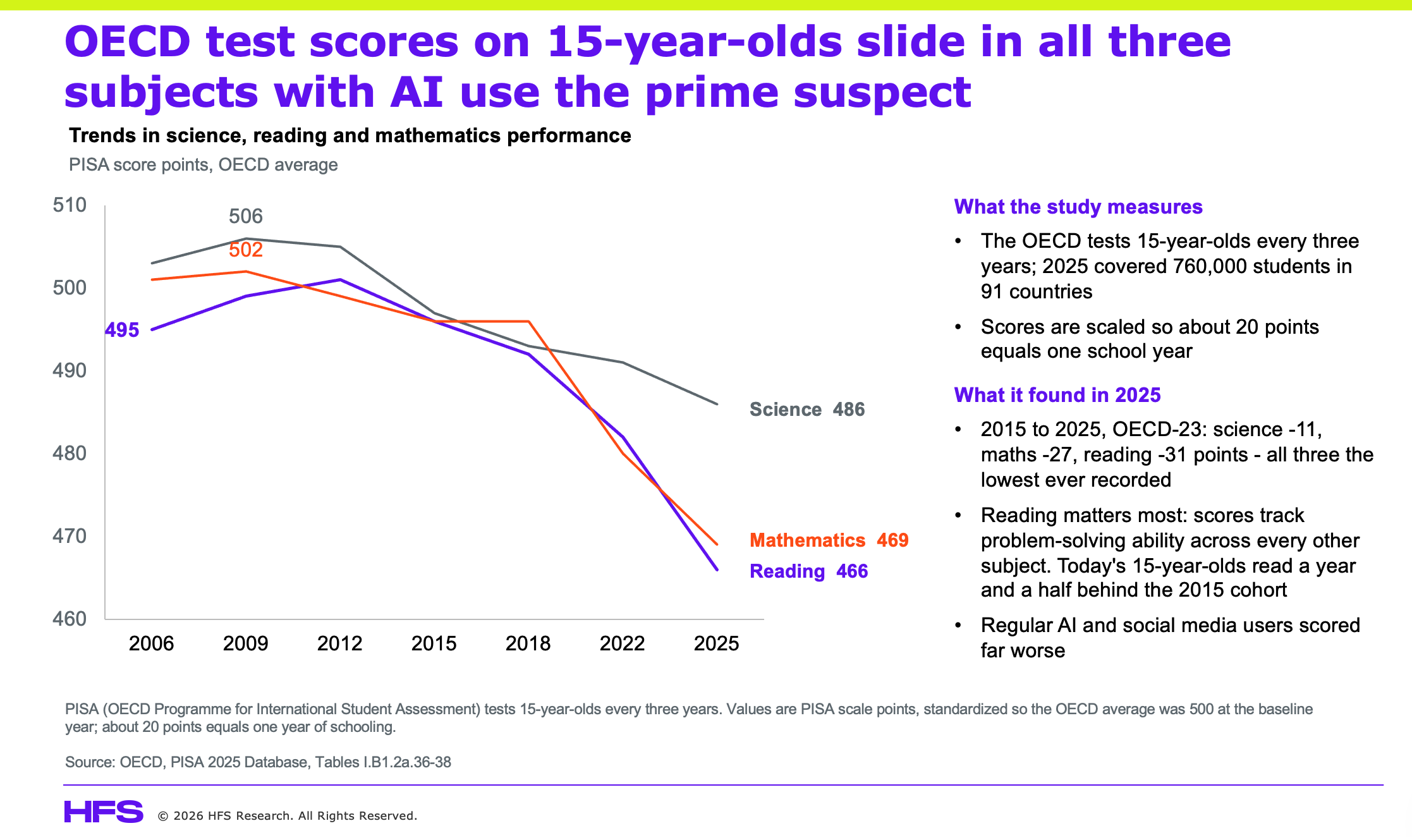
The OECD blames screens and the collapse of reading for pleasure, and has been forced to invent a category called hasty readers, who skim a passage and answer wrong at speed. Anyone who has skimmed a board pack on the way into the board meeting should feel free to look away. The capabilities falling fastest are evaluating information, connecting sources and judging whether something can be trusted. Go and read your own AI strategy. It is the same list, filed under what humans will still be needed for.
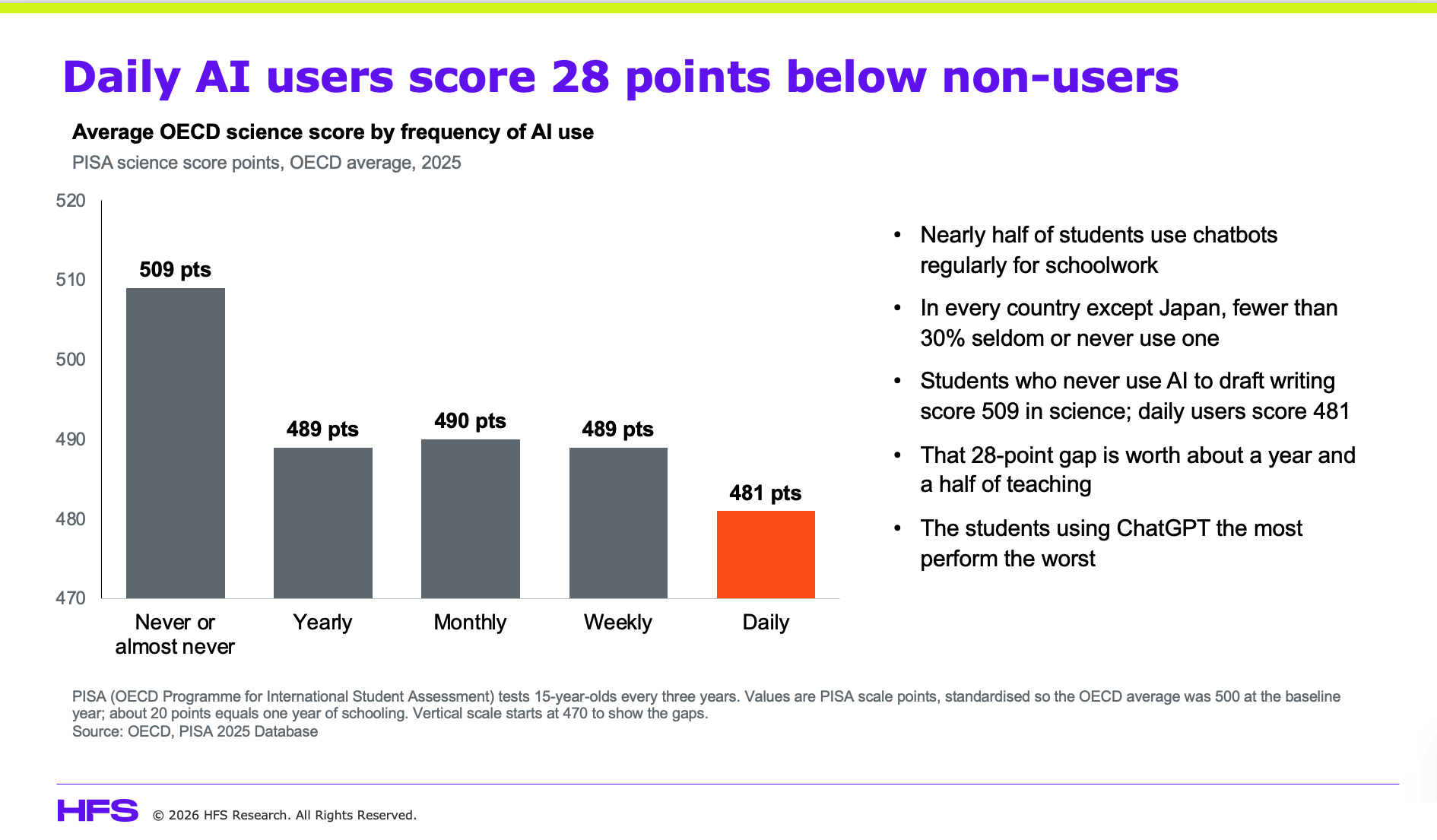
PISA asked about AI for the first time in 2025. Students who never use it to draft their writing scored 509 in science and daily users scored 481, with everyone in between flat at 489 or 490. Don’t get carried away: the kids leaning on AI every day were probably struggling already, and even the OECD won’t claim AI caused the gap:
So here’s the study that should really worry you. Researchers at a Turkish high school randomly handed some students ChatGPT, and that group solved 48% more practice problems, then scored 17% worse than the students who never had it once the tool was removed for the exam. Because it was random, you can’t blame weaker students this time.
Now for the bit almost nobody quotes. A version built with safeguards gave hints instead of answers, which is to say it behaved like a decent manager. Practice improved 127%, and on the unassisted exam those students finished level with the control group. No damage at all. The only difference was a product setting, which means somebody, somewhere, chose the other one for you.
Expertise is getting more expensive, and we just closed the factory that makes it
This would matter less if experience were going out of fashion. Annoyingly, it is having a moment. Stanford Digital Economy Lab analysis of US payroll data shows employment for 22 to 25-year-olds in the most AI-exposed occupations down about 11% since late 2022, while the same age group in the least exposed work rose about 10%. The gains are concentrated among experienced people in work that depends on knowledge you can only get by doing the job badly for a while first. We are bidding up judgment and closing the only factory that makes it.
What is at stake is error detection. These systems are confidently wrong in ways nobody can predict, and the only thing between a plausible answer and an expensive decision is somebody experienced enough to smell it. Every organization needs an adult in the room. We have stopped manufacturing adults.
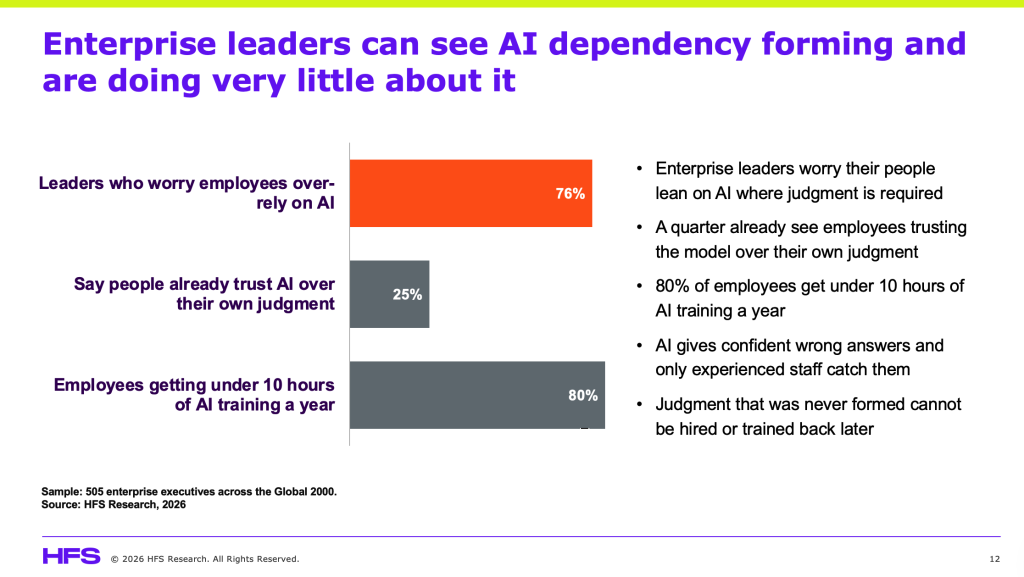
The pattern is already loose in the building. Our 2026 study of 505 enterprise executives found 76% worried their people lean on AI where judgment is required, and a quarter reporting employees who already trust the model over their own judgment. Meanwhile, 80% of employees get under ten hours of AI training a year, which is to say a 40-minute module and a badge.
And none of it can be bought back later. You can hire your way out of attrition and train your way out of a skills gap, but judgment that was never formed is not for sale at any price, least of all when every firm in your sector spent the same decade not forming it. You can’t poach from an empty pool.
Making an expert takes eight years, and nobody is paying for it anymore
Nobody proposed abolishing the apprenticeship. They proposed pyramid optimization, capacity release and outcome-based commercials, usually under a slide titled “Future-Ready Workforce”. But the pyramid did a second job, as junior work produced something the business needed, so the cost of learning was buried inside productive output and never appeared in any training budget. Professional services made the subsidy visible, with junior hours billed at rates that funded the learning years, but the same arrangement ran through every enterprise function where juniors became useful by doing real work. Optimize the junior tasks away and the learning goes too, because it never had a line of its own. It was the only training budget nobody ever cut, mostly because nobody knew it was there.
Every decision along the way is rational. Making an expert takes eight years and mostly benefits whoever hires them in year nine. Buying one takes a recruiter and a Tuesday. Nobody was ever promoted for protecting the learning curve of a 23-year-old. So everyone waits for someone else to pay for it, and the talent pool quietly drains. No single firm can fix that on its own.
Everyone making these decisions was carried through their own useless years on somebody else’s budget. We are now pulling the ladder up and filing it under efficiency.
Humans can’t stay at the helm if we stop teaching them how to steer
Every enterprise AI strategy ends with a human in the loop, catching the error and owning the decision. It looks great on a slide. Where does that human come from, what forms them, and who pays for it now the tasks that did the forming are on a slide marked automate?
So go faster than your competitors if you can. Just stop assuming capability maintains itself, because it never has. Four moves, and the window is this planning cycle, not the one after it.
- Demand tutor mode. Safeguarded design removed the damage entirely in the only trial we have, which makes it a product requirement. Providers should ship modes that build the user while they do the work, and enterprises should stop buying the ones that do not.
- Ring-fence the learning work. Pick a percentage of junior time that stays un-accelerated, on the tasks that build pattern recognition, and fund it as development with a named owner. Aviation mandates hours flown by hand and medicine counts cases in residency, because neither industry trusts individuals to choose the slower path in a busy week. Then make every automation proposal name the capability the deleted task was building and say where it gets built instead.
- Buyers, put it in the contract. The people who will run your account in five years are being made, or not made, inside your provider’s pyramid right now. Ask for graduate intake numbers and the experience mix on the account, and hold the answer where the key-person clauses already sit.
- Then measure it annually, like attrition. Take the tool away on a sample task and see what is left. If performance falls off a cliff you have measured dependency, and you are holding a number your competitors do not have.
The Bottom Line: Use AI to amplify human capability, never to replace the process that builds it.
These 15-year-olds start showing up in your graduate intake around 2031 and will be running your business by 2045. How they develop between now and then is being decided today, and most of the people deciding it are focused on cost takeout, not capability. You will get either a generation that learned to think alongside these machines or one that learned to wait for them, and there is no retrofitting the difference.
Offload the grunt work by all means. Just plant something in the space it leaves, this year, while there is still time for it to grow. Nobody has ever harvested a workforce they forgot to sow.
Sources
- OECD PISA 2025 Database, 760,000 students across 91 countries, with HFS Research analysis. Exhibits 1 and 2 show OECD averages. The OECD cautions explicitly against reading its AI use correlations as causal.
- Bastani, Bastani, Sungu, Ge, Kabakci and Mariman, Generative AI Can Harm Learning, 2024. Randomised field experiment, nearly 1,000 students in a Turkish high school. GPT Base improved assisted practice by 48% and cut unassisted exam performance by 17% against control. GPT Tutor, with learning safeguards, improved practice by 127% with exam performance statistically indistinguishable from control.
- Stanford Digital Economy Lab, August 2026 update, on employment for workers aged 22 to 25 in AI-exposed occupations.
Posted in : Agentic AI, AGI, Anthropic, Artificial Intelligence, ChatGPT, Claude, Education, GenAI, Government Policy, OpenAI