The AI gold rush is leaving households with the bills, workers with the fear, and shareholders with the upside. Voters rejected data centers in 40 of 41 ballot measures last week, and 57% of Americans now say AI is bad for society.
We have just witnessed the moment the AI industry discovered a constraint it cannot solve by throwing more multi-billions at compute. On November 3, voters favored limits on data centers in 40 of 41 local ballot measures tracked by Ballotpedia, while an October ABC News/Washington Post/Ipsos poll found that 57% of Americans viewed AI as bad for society.
These are not people who have suddenly turned against innovation. They are people wondering why a technology supposedly being built for human progress is asking them to bear so much of the cost. AI’s social license has to be earned through visible benefits, honest leadership, and accountability for outcomes, and right now the industry is failing on all three.
For three years, hyperscalers, AI labs, software vendors and service providers have been selling the promise of AI to boards and Wall Street with extraordinary enthusiasm, yet they have done a miserable job explaining how the people whose jobs, livelihoods and communities are being upended will actually benefit. We have built an industry that can calculate the cost of training a model down to the last dollar, but still struggles to say who takes responsibility when electricity bills rise, career opportunities disappear, or an AI system harms someone. If you run a hyperscaler, an AI lab, or a services firm, or you sit on the board of an enterprise betting its operating model on AI, this is your problem to fix, not a regulator’s.
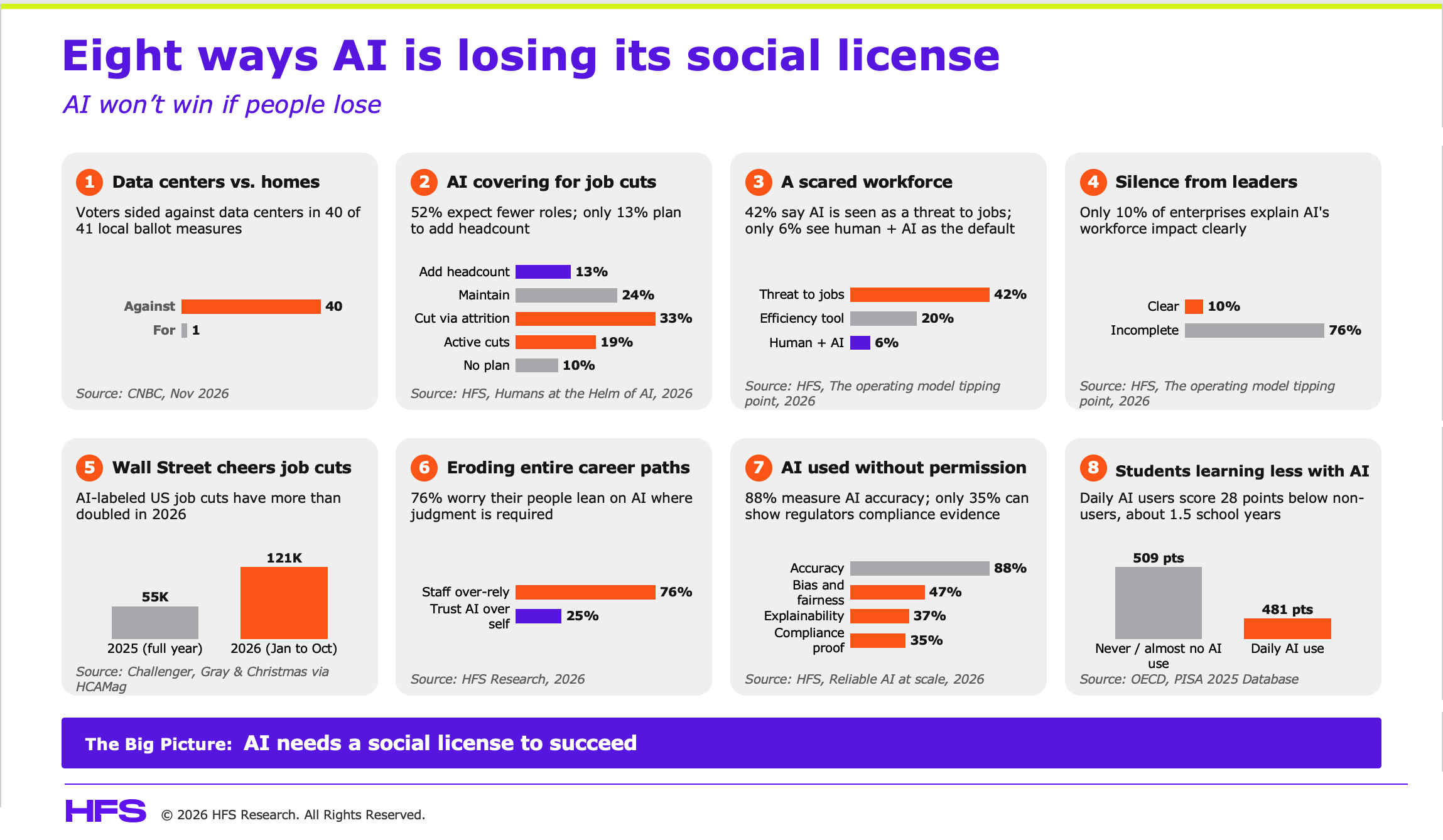
This is much more than a public relations problem. It is a growing crisis of trust and accountability that threatens the very social license AI needs to operate at scale. We discuss eight reasons why the AI social license is slipping away (click to enlarge):
Sources: HFS Research, Ballotpedia, ABC News/Ipsos, OECD and Challenger, Gray & Christmas
1. Data centers are asking families to subsidize the AI gold rush
The technology industry celebrates each multibillion-dollar data center as proof that the AI future is arriving, but the family down the road does not want to find out that it is helping pay for another company’s valuation through higher utility bills or strained local infrastructure. The scoreboard above is unambiguous, with voters siding against the data center in 40 of the 41 local ballot measures. The national mood is no kinder, since 66% of Americans now oppose building new data centers in the US, according to the same ABC News/Washington Post/Ipsos poll, and that opposition climbs to 72% when the site would be in their own community. Communities are entitled to ask what they are getting in exchange for the demands on their electricity grids, water supplies and land, and promises about future prosperity are a poor substitute for credible commitments today. OpenAI’s pledge is welcome, but a promise issued the day before voters rejected 40 data centers is a reaction, not a strategy. Paying your own way should be the starting condition for the entire industry, not something communities have to fight for.
2. AI is becoming the most convenient excuse for cutting people
Far too many layoffs now being attributed to AI were already coming because of overhiring, margin pressure or management failure, and we should stop pretending that every cost-cutting exercise represents some breakthrough in enterprise transformation. Most companies have barely begun to redesign the processes, workflows, and operating models that actually determine whether AI creates value, yet many are already eager to present fewer employees as the proof of progress. Our own data bears this out, with 52% of the executives we surveyed expecting fewer roles, while just 13% plan to add headcount. This is old-fashioned cost reduction wearing an AI badge, and every layoff sold as an AI success story makes it harder for the public to believe this technology is being developed for their benefit. We have yet to see a business cut its way to sustainable growth without creating something better on the other side.
Further reading: Don’t hide behind AI to trim your belly fat. Start redesigning your workforce
3. The workforce is frightened, and leadership keeps making it worse
Our HFS Humans at the Helm of AI research, based on 505 senior executives, found that only 7% believe their employees feel in control of how AI is shaping their work, while 52% identified fear of replacement as the biggest barrier to AI engagement. Those findings should terrify any CEO still treating adoption as a software rollout, because employees who believe this technology is being done to them rather than built with them will not become enthusiastic participants in the transformation. Our operating-model research reinforces the point: 42% of executives say AI is seen inside their organizations as a threat to jobs, and only 6% describe human plus AI as the default way of working. Companies need to give people agency over the redesign of their jobs, a credible path to new skills and a meaningful share in the opportunity, rather than expecting them to applaud their own redundancy.
Further reading: Humans at the Helm of AI
4. Leadership silence is turning uncertainty into resistance
CEOs can tell investors what AI might do for productivity and margins, but too many still cannot explain to their own employees what it will mean for their careers, their teams or the work they do every day. That vacuum is being filled with rumors, anxiety and the growing suspicion that management has a plan for technology but no plan for people, while middle managers are being asked to execute changes they scarcely understand themselves. Only 10% of enterprises give their people a clear account of AI’s workforce impact, and 76% offer at best an incomplete picture. You cannot win consent for a transformation you are unwilling to explain. Real leadership means telling people what is changing, where the new opportunities will come from and what the enterprise is prepared to invest in getting them there.
5. Wall Street is starting to look anti-employment
It is becoming disturbingly easy for a CEO to earn applause by announcing that AI will enable the company to operate with fewer people, while the harder question of what new value those same investments will create is barely asked. Wall Street has become anti-employment, rewarding the removal of jobs more readily than the reinvention of work, and that is a dangerous message to send to the millions of people who are expected to trust this technology. The numbers tell the story: AI-attributed US job cuts have more than doubled, from 55,000 across the whole of 2025 to 121,000 in the first ten months of 2026, according to Challenger, Gray & Christmas. Investors can reward a restructuring, and boards can approve a productivity target, but neither can grant the social license that comes from people believing their future is improving. If AI is seen as a wealth-creation machine for shareholders and a job-destruction machine for everyone else, the political backlash will intensify.
6. We are destroying the talent pipeline we will need tomorrow
The entry-level work that AI can now automate is often the very work through which young people learn professional judgment, customer empathy, the culture of a business, and the skills that eventually make them valuable leaders. Professional services firms should be particularly concerned, because removing junior roles without rebuilding apprenticeships will hollow out the next generation of expertise that our industry depends on. Already, 76% of leaders worry that their people lean on AI where judgment is required, and a quarter say staff trust AI over their own judgment. The answer is not to mourn the old pyramid, but to build a doer model in which people use AI to take responsibility earlier, learn faster, and deliver more meaningful outcomes. If everyone delegates the same tasks to the same models, what eventually distinguishes one company from another is the human capability it has bothered to develop.
Further reading: The hidden debts of firing-as-a-service; Professional services firms must invest in young talent or lose their identities to AI
7. AI is being imposed on people without their consent
A social license depends on permission, and the controversy over nonconsensual sexualized images generated using Grok earlier this year exposed how quickly that permission can be violated when technology outruns basic human safeguards. X subsequently restricted access to certain image-generation features, but the damage to public confidence was already done, and enterprises should not assume that the problem is confined to consumer platforms. Businesses are deploying AI systems that influence hiring, decisions, and customer experiences faster than many can demonstrate who is accountable, how decisions can be challenged, or what happens when somebody is harmed. Our Reliable AI at Scale research found that 88% of enterprises measure AI accuracy, yet only 35% can show regulators evidence of compliance, and fewer than half test for bias and fairness. If an organization cannot explain whose data it is using, who approved the use, and who will take responsibility when something goes wrong, it has no business calling that responsible AI.
8. We are risking a generation that can prompt but cannot think
The OECD’s PISA 2025 results should make every parent, educator, and business leader pay attention, because students who used AI for certain schoolwork tasks, including summarizing and drafting, scored on average roughly 20 points lower in science than nonusers. The gap widens at the extremes: daily AI users averaged 481 points, compared with 509 for students who never or almost never use it, a 28-point difference equivalent to roughly 1.5 school years. The OECD is careful to say this relationship does not prove AI caused lower performance, and it also finds that students taught to use AI critically can benefit, but that distinction strengthens rather than weakens the argument. If we encourage young people to outsource the thinking before they have learned how to think, we risk creating a generation that is fluent at producing answers but increasingly short on judgment. The same danger exists in the workplace when executives confuse rapid output with real understanding.
Further reading: AI brain rot starts in the classroom and ends in your enterprise
Bottom line: Earn the social license now, or the public will take the decision out of your hands
The answer is not to slow innovation for its own sake, but to stop treating the people affected by AI as an afterthought. A social license is not a branding exercise, a responsible-AI slide in an investor deck, or another set of promises from technology leaders who are unwilling to own the consequences of their products. It has to be earned through visible benefits, honest leadership and accountability for outcomes. These seven commitments are the terms of that license.
- Pay your own way. AI infrastructure owners must cover the full electricity, grid, and community costs they create, with commitments local people can verify and enforce.
- Tell people the truth. Explain role by role what AI will change, what the transition will mean, and where the new opportunities for employees will come from.
- Redesign work before removing workers. Fix the broken processes and operating models first, and use productivity gains to create better services and new growth, not just fewer paychecks.
- Share the upside. Reinvest a meaningful share of AI gains in skills, careers, customers, and communities, instead of delivering all the benefits to shareholders.
- Build a new talent ladder. Redesign entry-level roles around learning, judgment and meaningful responsibility so that AI develops the next generation rather than replacing it.
- Put a named human on the hook. Require consent, transparency, auditable decisions, and an accountable owner who can provide redress when AI causes harm.
- Measure real outcomes, not layoffs. Judge AI by performance, personalization, prediction and productivity, alongside its impact on customers, employees and society.
We are deeply convinced that AI can transform how enterprises operate, create entirely new businesses and improve lives, but we refuse to accept the notion that its success should be measured primarily by stock-market valuations, the size of data centers or the number of jobs that disappear. The industry has spent three years celebrating what AI can do, and it is time for the companies making all these promises to prove whom it is actually for. Chips can be bought, models can be trained, and billions can be raised, but nobody can purchase public permission to operate in a society that feels increasingly excluded from the benefits. If our industry does not take ownership of that reality, voters, regulators and employees will force the issue for us. AI will not win if people lose.
This blog is inspired by the bold HFS 2030 Vision for Services-as-Software, a transformative outlook on how technology will redefine the way enterprises operate.
Posted in : Agentic AI, AGI, AI Harness, AI layoffs, Anthropic, Artificial Intelligence, GenAI, Google, Governance, Large Language Models (LLMs), Leadership, OpenAI