Our industry has become obsessed with building ever more capable AI models, while enterprises have become equally obsessed with gaining access to them.
Every week brings another benchmark, another frontier model, and another announcement that promises to reshape the AI landscape. Just recently, Moonshot AI’s Kimi 3 was the latest reminder that intelligence at the model layer is becoming more capable, more affordable, and increasingly interchangeable.
That’s great news for enterprises, but it also raises a more important question: If every enterprise rents increasingly powerful intelligence from the same handful of providers, from where will lasting competitive advantage actually come?
The answer is not yet another foundation model, but building intelligence that is unique to the enterprise.
Every organization possesses decades of accumulated expertise that no public model can replicate. It exists in the judgment of experienced employees, the way critical decisions are made, the nuances of customer relationships, industry-specific operating practices, and the battle scars and countless lessons learned through years of execution. That knowledge has always been the real differentiator, yet most organizations have never treated it as a strategic asset. Instead, it remains scattered across people, processes, applications, and documents, becoming increasingly difficult to capture, improve, and retain. As we recently researched, there is $18 trillion in trapped value just wasting away in our Global 2000 organizations. Are these really enterprise debts, or is this the value that needs to be unleashed that keeps them unique?
Services-as-Software™ defined: transforming human expertise into enterprise intelligence
This is precisely why HFS has evolved the concept of Services-as-Software™ (SaS). What began as a way for services and software providers to transform expertise into scalable digital capabilities has become something much broader:
Services-as-Software™ is the HFS operating framework that enables enterprises to build Sovereign Enterprise Intelligence by capturing and codifying human expertise, then continuously improving it through execution.
Net-net, SaS combines AI, business context, enterprise data, and governance to create continuously learning digital capabilities that remain owned by the enterprise rather than becoming part of someone else’s intelligence.
Three principles underpin the SaS approach
Capture and codify human expertise. Organizations must transform human expertise into reusable digital capabilities rather than allowing critical knowledge to remain trapped within individuals, documents, or consulting engagements.
Retain sovereignty over enterprise intelligence. AI should be informed by enterprise context without enterprises surrendering the knowledge, operating logic, and business expertise that differentiate them. Enterprise intelligence must remain an enterprise asset, not become part of someone else’s competitive advantage.
Continuously learn from execution. Every workflow, customer interaction, and business outcome should strengthen the enterprise itself. SaS creates a continuous learning cycle in which execution improves the operating model, enriches enterprise intelligence, and elevates the skills and judgment of the people who work within it.
Traditional software automates transactions, and traditional services apply human expertise. Services-as-Software™ continuously transforms that expertise into enterprise intelligence that grows increasingly valuable through execution:
Building Enterprise Intelligence requires a new enterprise operating model
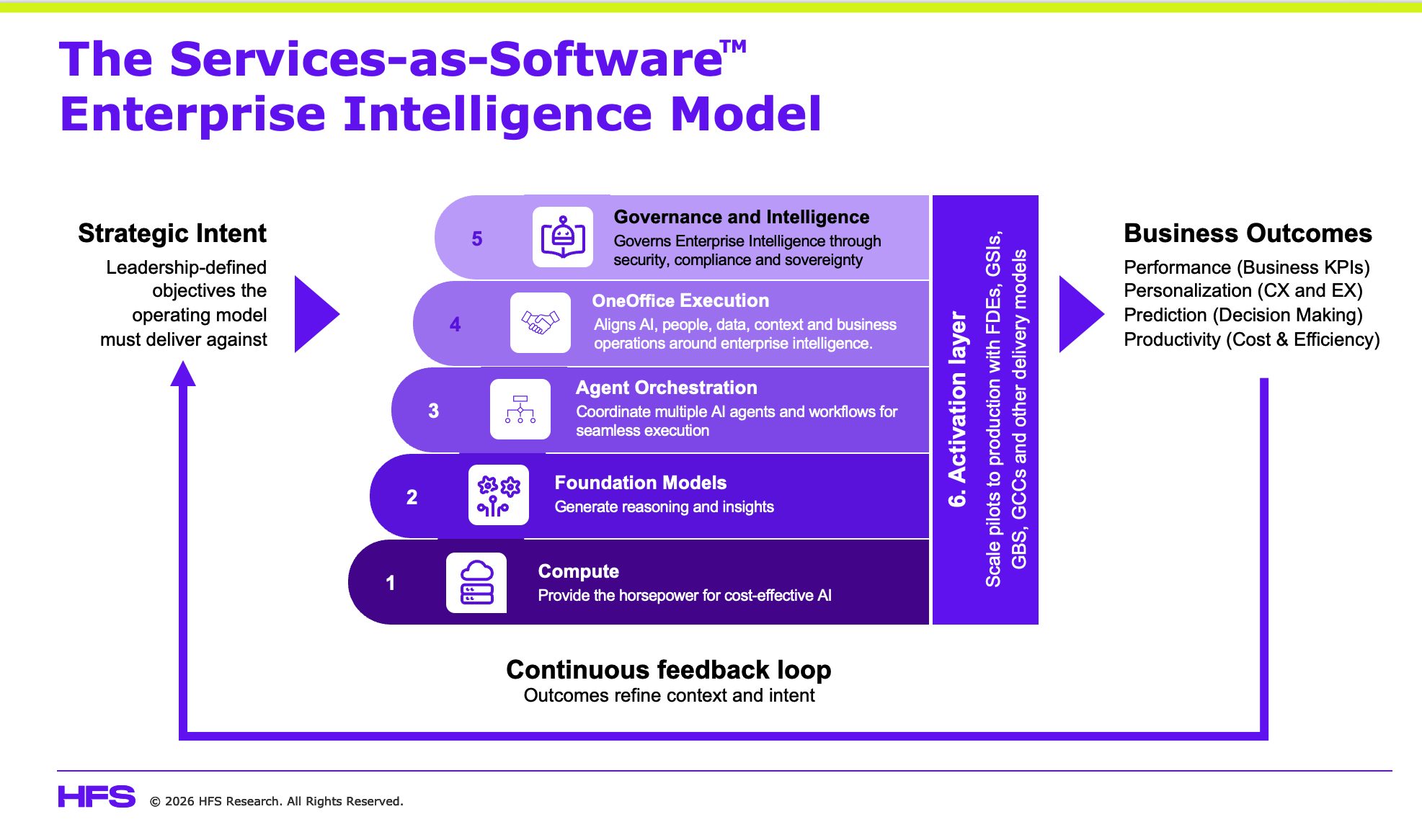
Define your Strategic Intent before you begin
Every operating model begins with intent because AI must never determine enterprise priorities. Leadership defines the strategic outcomes the organization wants to achieve, whether that is revenue growth, customer intimacy, operational efficiency, or innovation. The Services-as-Software Operating Model exists to continuously translate that strategic intent into business execution.
For example, a global retailer defines its strategic intent as improving customer loyalty while reducing fulfilment costs. Rather than deploying AI opportunistically across individual functions, that objective guides every layer of the Services-as-Software Operating Model, ensuring infrastructure, AI models, workflows, and OneOffice Execution all align around delivering measurable improvements in customer experience, inventory optimization, and profitability.
Layers 1 and 2: Compute and Foundation Models
At the Services-as-Software model foundation sits Compute, because every AI capability ultimately depends on accelerated infrastructure running across hyperscale clouds, sovereign environments, or enterprise data centers. Sitting above that are Foundation Models, which continue to improve at extraordinary speed and provide the reasoning, language, and multimodal capabilities that power enterprise AI. Those models remain essential, but they are increasingly becoming interchangeable components of the architecture rather than the architecture itself, allowing organizations to select whichever models best suit a particular workload without fundamentally changing how the enterprise operates.
Fo example, an automotive manufacturer deploys NVIDIA-powered compute across its private cloud and hyperscale environments while selecting different foundation models for engineering design, supply chain optimization, and customer support. Compute provides the horsepower, and foundation models provide the reasoning, but neither creates lasting differentiation because competitors can build a similar technology stack. The real advantage comes from how the enterprise applies those capabilities through its operating model.
Layer 3: Agent Orchestration
The next layer is Agent Orchestration, where multiple models, AI agents, and business workflows are coordinated into a single operating environment. As enterprises increasingly deploy specialized models and autonomous agents, this layer becomes the control plane that governs workflow execution, policy, security, and model selection, allowing organizations to evolve their AI estate without becoming permanently dependent on a single provider.
For example, a customer complaint triggers one agent to verify identity, another to retrieve account history, a third to recommend a resolution, and a fourth to complete the transaction, all coordinated automatically under a single governance framework.
Layer 4: OneOffice Execution
OneOffice Execution is where enterprise strategy becomes enterprise action because this is the layer where AI finally understands the context in which the business operates. Foundation models can reason, summarize and generate extraordinary outputs, but they have no inherent understanding of an organization’s customers, operating policies, regulatory obligations, commercial priorities or risk appetite. Those elements of context are what allow intelligence to become execution, which is why we believe OneOffice Execution becomes the most strategically important layer in the Services-as-Software™ framework.
This is where AI, people, enterprise data and business operations converge into a single execution model that continuously aligns strategic intent with operational delivery. Rather than allowing AI to operate inside disconnected functions or individual applications, OneOffice Execution connects the entire enterprise by orchestrating agents, workflows, business rules, governance and enterprise context across every customer interaction and operational process. Every decision is therefore made with an understanding of how it contributes to broader business objectives, while every process continuously enriches the Enterprise intelligence that makes the organization more competitive over time.
Context becomes the defining capability of this layer because enterprises do not compete on access to AI. They compete on how well AI understands their business. Every organization has unique operating policies, customer relationships, regulatory requirements, commercial priorities and decades of institutional knowledge that no foundation model can infer on its own. OneOffice Execution continuously injects that business context into every AI interaction, ensuring the intelligence being generated is relevant to the enterprise rather than generic to the model. This is also where Enterprise intelligence begins to compound because every workflow, customer interaction and operational decision feeds new knowledge back into the organization instead of enriching the external platforms providing the underlying AI.
Forward Deployed Engineers (FDEs) become the architects of this environment because their role extends far beyond building prompts or configuring AI agents. They work alongside business leaders to understand how work is actually performed, capture institutional knowledge, codify business policies, design AI-native operating workflows and continuously refine how AI executes across the enterprise. Their responsibility is to transform human expertise into reusable operating capabilities that improve through execution, ensuring the organization becomes progressively more intelligent every time the business runs.
This is fundamentally different from both traditional software and traditional services. Traditional software automates transactions inside predefined processes, while traditional services rely on people to interpret context and apply expertise. OneOffice Execution brings those two worlds together by allowing AI to execute work with the same business understanding that previously existed only inside experienced practitioners. The result is not simply faster execution, but an enterprise operating model that continuously learns, adapts and improves while retaining sovereignty over the intelligence it creates.
Consider an insurance provider where, historically, claims processing, underwriting, fraud detection and customer service have operated as separate functions, each supported by different systems, data and teams. Through OneOffice Execution, AI no longer optimizes those activities independently. Instead, it coordinates the entire customer journey by combining policy information, customer history, fraud indicators, underwriting rules, regulatory obligations and settlement decisions into a single contextual operating model. Every claim reaches a faster, more consistent and more accurate outcome, while every interaction simultaneously strengthens the Enterprise intelligence that informs every future underwriting decision, customer conversation and fraud investigation. The organization is therefore not simply processing claims more efficiently, it is continuously becoming a smarter insurer.
Layer 5: Governance & Intelligence
As AI becomes embedded across the enterprise, Governance & Intelligence becomes the capability that ensures enterprise intelligence remains trusted, secure, explainable, and continuously improving.
Enterprise intelligence is the accumulated institutional knowledge, business context, operating logic, and domain expertise continuously created through business execution, governed by the enterprise, and owned as a strategic asset.
Every workflow, customer interaction, and operational decision governed through OneOffice Execution contributes to enterprise intelligence, while governance ensures that intelligence remains trusted, secure, compliant, and uniquely owned by the enterprise.
Unlike traditional governance, which focuses primarily on managing risk and enforcing policy, Governance & Intelligence continuously strengthens the enterprise’s operating model. Security, compliance, digital sovereignty, explainability, and human oversight are embedded directly into AI execution, ensuring that Enterprise intelligence evolves responsibly while remaining protected from external platforms. Every governed interaction enriches the organization’s institutional knowledge, business context, and operating logic, allowing AI to become progressively more accurate, more contextual, and more valuable over time.
This transforms governance from a control function into a strategic capability. Foundation models may provide reasoning, but Governance & Intelligence ensure that reasoning is continuously refined through enterprise knowledge, protected through robust governance, and converted into a proprietary strategic asset that competitors cannot simply license or replicate.
Consider a global pharmaceutical company that continuously governs AI-driven clinical research, regulatory submissions, and manufacturing decisions through OneOffice Execution. Every governed interaction strengthens its Enterprise intelligence while ensuring regulatory compliance, data sovereignty, and patient safety, allowing the organization to innovate faster without compromising trust or control.
Layer 6: Activation
Most enterprises already know how to pilot AI. Very few know how to operationalize it at enterprise scale. That is the role of the Activation Layer. The Activation Layer bridges the gap between experimentation and production by combining Forward Deployed Engineers, Global Capability Centers, business leaders and services partners to industrialize AI across the enterprise. It is where isolated pilots become repeatable operating capability.
A successful AI pilot is only the beginning. For example, a global logistics company uses the Activation Layer to transform an AI scheduling pilot into a global operating capability by combining Forward Deployed Engineers, Global Capability Centers, business leaders and services partners to standardize workflows, governance, training and adoption across more than 50 countries. The result is not simply wider deployment of AI, but a continuously improving operating model that becomes smarter with every shipment.
Business Outcomes become the feedback loop that continuously strengthens Enterprise intelligence
Business Outcomes are not simply the final layer of the Services-as-Software™ operating model because they provide the evidence that the operating model itself is learning. Traditional software measures success by whether a transaction was completed or a process was automated, while Services-as-Software measures success by whether every outcome improves the Enterprise intelligence that drives the next decision. Every customer interaction, operational workflow and business result feeds back into the operating model, refining business context, strengthening governance, enriching Enterprise intelligence and continuously improving future execution.
This creates a fundamentally different way of operating because the organization is no longer just executing work more efficiently. It is learning from execution itself. Success is therefore measured not only by faster cycle times, lower costs or higher productivity, but by whether the enterprise becomes progressively smarter every time the business runs. Over time, that learning compounds into a strategic asset that competitors cannot simply replicate by licensing the same foundation models.
For example, a healthcare provider reduces patient waiting times by 40%, improves clinical outcomes and lowers operating costs because its Services-as-Software operating model continuously learns from every diagnosis, treatment pathway and patient interaction. Clinical decisions become more consistent, care pathways become more personalized and operational bottlenecks are identified earlier because every patient journey strengthens the Enterprise intelligence guiding the next one. The result is not simply better healthcare delivery. It is a healthcare organization that becomes progressively more intelligent every day it operates.
The Continuous Feedback Loop: Where the operating model continuously learns
Unlike traditional operating models, which optimize static processes, the Services-as-Software Operating Model continuously improves itself. Every business outcome feeds back into the operating model, refining enterprise context, improving governance and strengthening Enterprise intelligence. Success is therefore measured not only by today’s performance but by how much smarter the enterprise becomes tomorrow.
For example, a manufacturer deploys AI to optimize production scheduling across dozens of factories. As production outcomes improve, data on quality, machine performance, supply chain disruptions and customer demand continually feeds back into the operating model. Those insights refine business context, improve agent decision-making and strengthen Enterprise intelligence, allowing every production cycle to perform better than the last.
Bottom line: Enterprise Intelligence is becoming the defining strategic asset of the AI era
Phase 1 of enterprise AI was about gaining access to intelligence. Phase 2 is about creating intelligence that your competitors cannot access because it is built from your organization’s own expertise, operating context, and continuous learning.
Services-as-Software™ provides the operating framework for making this possible. It transforms human expertise into Enterprise Intelligence, protects the knowledge that differentiates your enterprise, and ensures every business outcome strengthens your organization rather than an external platform.
Every enterprise will soon have access to increasingly capable AI. The organizations that are already leading their industries are those that continuously build enterprise intelligence through Services-as-Software™, because that is the one asset their competitors can neither license nor replicate.
Posted in : Agentic AI, AGI, Artificial Intelligence, Business Process Outsourcing (BPO), Buyers' Sourcing Best Practices, GCCs, Governance, IT Outsourcing / IT Services, Large Language Models (LLMs), Leadership, Sovereign data