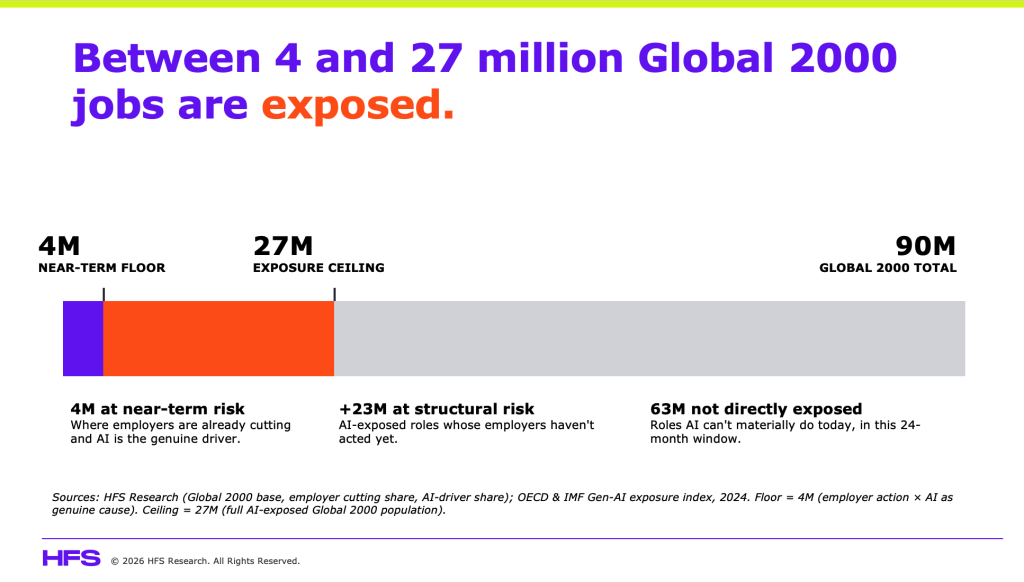
Twenty-seven million. That is the number of corporate roles across the Global 2000 that HFS Research identifies as meaningfully exposed to AI-driven elimination, displacement, or fundamental redesign over the next three years. Not factory-floor jobs or gig roles, but 27 million white-collar, salaried, benefits-eligible positions held by people who built careers on the assumption that their employer had a plan for the future.
Sadly, most employers do not, and the workers carrying the most exposure are the ones least likely to know it:
Credibility and trust of leadership are at stake when layoffs are made under a false AI narrative
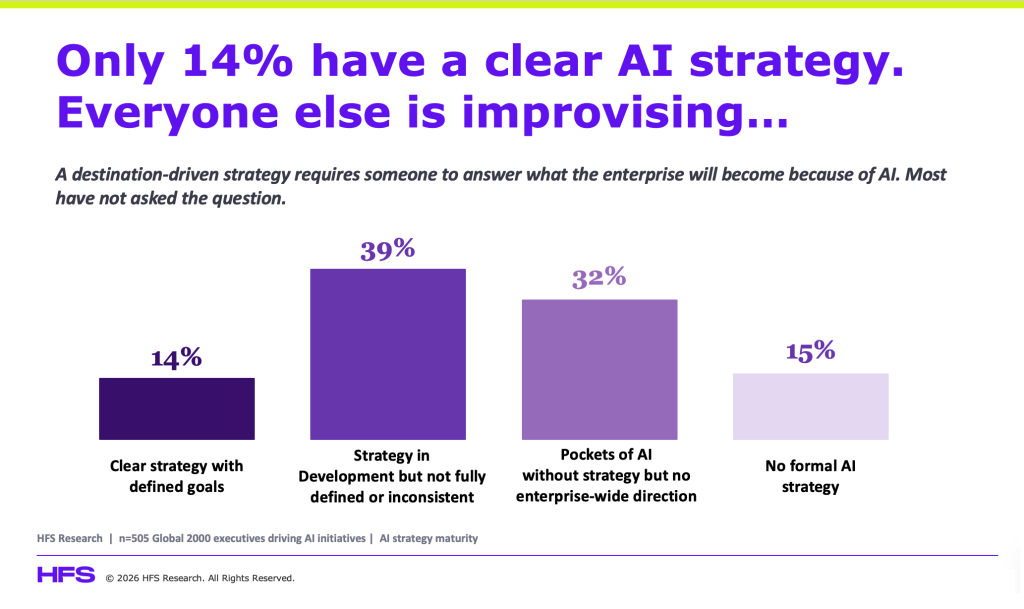
Most of the organizations sitting on top of these 27 million exposures have no coherent plan for what they are doing with AI, let alone what happens to the people inside it. Our research across 505 AI leaders across the Global 2000 tells us only 14% have a clear enterprise AI strategy with defined goals and outcomes. The remaining 86% are split between strategies that are still developing and inconsistent (39%), AI activity that exists only in pockets with no enterprise direction (32%), and no defined strategy at all (15%).
Exhibit 1: Only 14% have a clear AI strategy. Everyone else is improvising.
“We’re restructuring for the AI era” sounds considerably better on an earnings call than “we spent two years in meetings about AI and have absolutely nothing to show for it.” Both announcements produce roughly the same stock reaction, but one of them is a strategy and the other is a prayer dressed up in a press release. At some point over the next few months, a CEO in your industry will announce a major workforce reduction and call it an AI transformation. The board will nod, and investors will reward the action. And somewhere in a conference room near you, someone is going to ask why your organization is not doing the same thing.
That moment is coming. For millions of workers across the Global 2000, it will not feel like a transformation. It will feel like they have sorely misplaced their trust in a leadership that is finally running out of road.
Enterprises are shrinking before they have figured out what they are rebuilding
AI is becoming the justification for decisions that were already forming, not the cause of them. The language will be about transformation. The reality will be a spreadsheet that was already open before the AI strategy was written, and a mounting leadership debt that is now being called in.
Because at the center of all of this is a simpler problem. There is no human accountability at the helm of AI, and enterprises are shrinking before they realize what they’ll need to rebuild. HFS Research estimates that between 17 and 20 million workers sit inside Global 2000 organizations with no clear AI strategy, no meaningful investment in their people, and no plan for what comes next. These workers are already living the consequences of decisions their leadership hasn’t made, and desperately need the training and resources they haven’t provided.
The current wave of layoffs is largely a smoke screen. The harder wave has not hit yet.
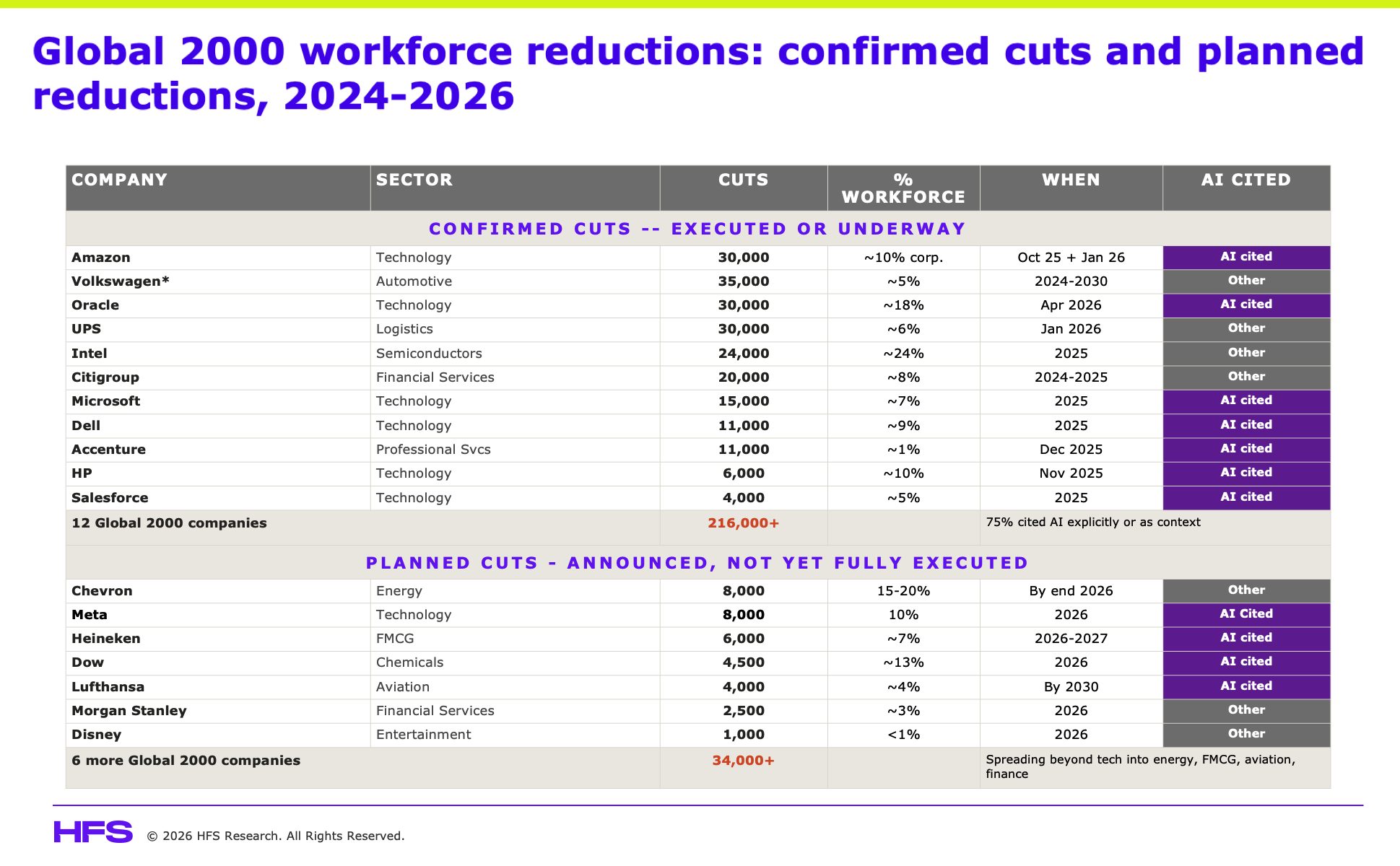
More than 216,000 roles have already been cut across just 12 Global 2000 companies since 2024, with 71% of those announcements citing AI as a driver (See Exhibit 2). But look a little closer at what those companies were actually doing. Oracle cut 30,000 roles while committing $300 billion to AI infrastructure. Amazon eliminated 30,000 corporate positions while investing $80 billion in AI in the same year. Microsoft reduced 15,000 roles in the same quarter it said AI was generating 30% of its code.
These are not distressed companies cutting from weakness. They are cutting with intent, removing what no longer fits while investing heavily in what comes next. The problem is that now everyone thinks they can do the same thing and the narrative travels faster than the capability behind it. No roadmap is required, no real AI muscle needed. Just the right language and a board that has been waiting long enough to want a number. As this spreads across the Global 2000 and the bandwagon forms, the trend will be mistaken for strategy. That is where we hit the danger zone.
Exhibit 2: Global 2000 workforce reductions: confirmed cuts and planned reductions, 2024-2026
The organizations feeling this pressure the most are the ones with the least to show.
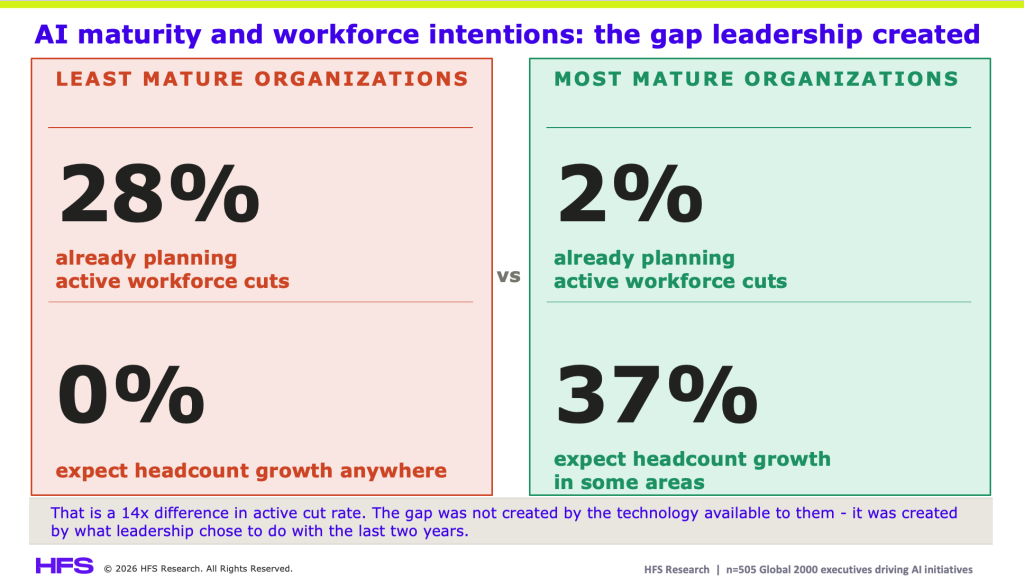
Cutting tens of thousands of roles while investing billions in AI infrastructure requires having billions in AI infrastructure to invest in. Most do not. The organizations heading toward the most damaging reductions the ones reacting through headlines without thinking through capabilities. In our latest study, we found that 28% of the least AI-mature organizations in the Global 2000 are already planning active workforce cuts. Among the most mature, 2%. Zero percent of the least mature expect to grow headcount anywhere. Among the most mature, 37% do.
The organizations in the 2% are cutting toward something. The organizations in the 28% are cutting because someone looked at the headlines, asked why we are not doing the same, and nobody in the room had a good answer. That is leadership debt.
Exhibit 3: AI maturity and workforce intentions
Across the Global 2000, a significant share of organizations still sit in low to mid levels of AI maturity. When you map that distribution against workforce exposure, the numbers become difficult to ignore: 17 and 20 million roles could be exposed to reactive reduction over the next two to three years, concentrated heavily in organizations that have not yet moved beyond experimentation (See Exhibit 4).
Exhibit 4: Of 90 million Global 2000 workers, where does the risk sit?
Leadership did not find the frozen middle. Leadership built it.
The organizations on the wrong side of that maturity gap ended up there because of choices that felt reasonable at the time and compounded quietly until the board ran out of patience. AI was delegated to the function best equipped to install it, not the function best equipped to lead it. The CIO got the roadmap, the CEO got the quarterly update, and somewhere between those two things, the actual decisions about what the organization was becoming, what work would change, and what the workforce needed to know never got made.
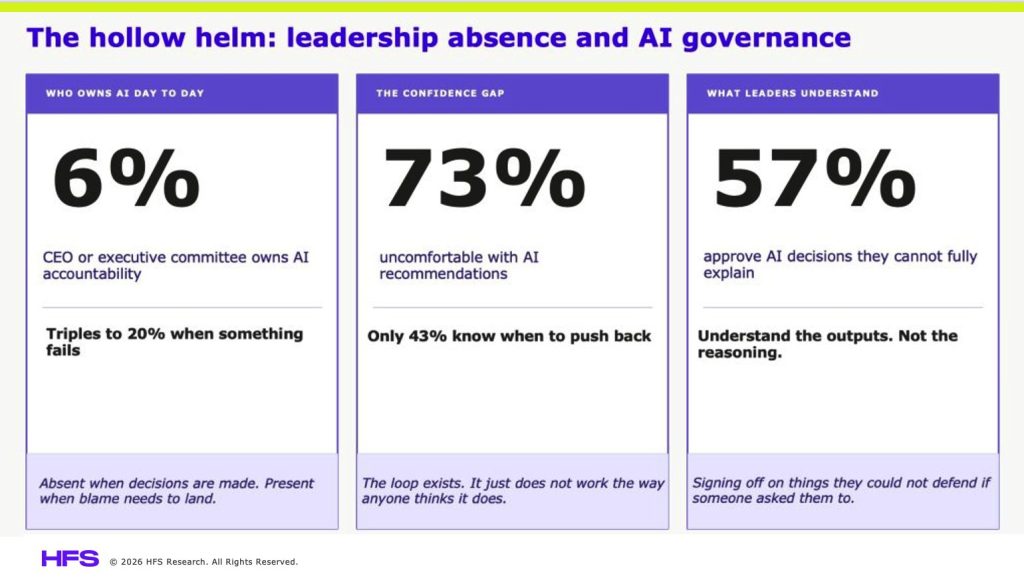
Our research puts a number on what that looks like in practice (Exhibit 5). Only 6% of CEOs own AI accountability day to day, though that number triples when something fails. 73% of leaders are uncomfortable with AI recommendations, but only 43% know when to push back, and 57% approve decisions they cannot fully explain. Nobody owns it, nobody can challenge it, and nobody can defend it when the board asks what two years of investment have actually produced.
That is the moment the conversation stops being about strategy, and someone opens a spreadsheet looking for a number, not because AI failed to deliver, but because leadership could never show that it had.
Exhibit 5: When it comes to AI in major enterprises, nobody owns it, few can challenge it, or defend it
Executives expect AI to eliminate the resource and skills constraints, but many are choosing to eliminate the resources first.
If this moment is being misread, it is because too many organizations are reacting to outcomes instead of defining them.
The companies getting this right are not moving faster and with intent. They know what AI is changing, where they are investing, and how their workforce is evolving as a result. Everyone else is still trying to reverse-engineer a strategy from someone else’s announcement.
This is the point where leadership either takes control of the direction or defaults to reacting to it. The difference shows up quickly, and the workforce is where it becomes visible.
Here is what needs to happen next:
- Stop using AI as an explanation and start using it as a decision framework. If you cannot clearly articulate what AI is changing in your business, you are not ready to make workforce decisions tied to it.
- Assign real ownership, not shared accountability. AI cannot sit across committees and still be directed with intent. One team, one leader, clear accountability for outcomes.
- Move from pilots to irreversible decisions
If your AI efforts have not changed how core work gets done, you are still experimenting. Start redesigning workflows, not just testing tools. - Define what you are building before deciding what to cut. Headcount reductions without a clear future state will hollow out capability rather than build it.
- Invest in people at the same level as you invest in technology. AI capability without workforce capability creates dependency, not advantage.
- Resist copying what the market rewards. Other companies’ cuts are not your strategy. Without the same maturity and direction, the outcome will not be the same.
The Bottom line: You cannot shrink your way into an AI strategy
Align AI to growth by purposefully remodeling your workforce.
AI will reshape the workforce. The only real decision is whether leadership does it deliberately or whether the market does it for them. The leadership debt that’s been accumulating for two years is coming due; will it be repaid through strategy and capability, or will the workforce bear its burden?
Posted in : Agentic AI, AGI, AI layoffs, Artificial Intelligence, Automation, Change Management, Economy, Politics