But the same work you celebrate with your GCC is exactly what agentic AI is targeting first
Too many GCC leaders are blissfully ignoring the fact they could be faced with evaporation by agentification
We’ve already called out that the next 18 months will witness the dying embers of labour-intensive services. That includes your GCC. If your GCC focuses predominantly on repetitive manual tasks it’s little more than a transaction factory, and it’s the first thing the board will look to automate next. It won’t gradually downsize or pivot, but will likely experience rapid and devastating headcount reductions. Just because the labor costs are lower doesn’t negate the fact these are still costs.
This isn’t about AI replacing every GCC, but instead boards questioning why they are funding models that don’t create a competitive advantage. That’s why some GCCs are becoming increasingly relevant, and our GCC Temperature Check will expose the realities of your situation, and we lay out how you pivot to an innovation engine.
Most GCCs perform work that agents will execute better, faster, and cheaper
The uncomfortable truth is that your GCC is likely built around delivering scale and speed at a reasonable price point, and that strength has become its biggest liability. When AI eliminates the foundation of its work, what’s left? A bloated cost structure. GCCs have become victims of their own success and now face the same automation threat as traditional BPOs. That’s when they evaporate.
We’ve carefully examined HFS’ GCC database and mapped each center into one of three categories outlined below. The majority are indeed transaction factories, and GCC leaders have admitted it to us themselves. Very few GCCs have grown into an operations hub, and even fewer are AI-native innovation hubs. That means the vast majority are just waiting to be disrupted.
What type of GCC do you have?
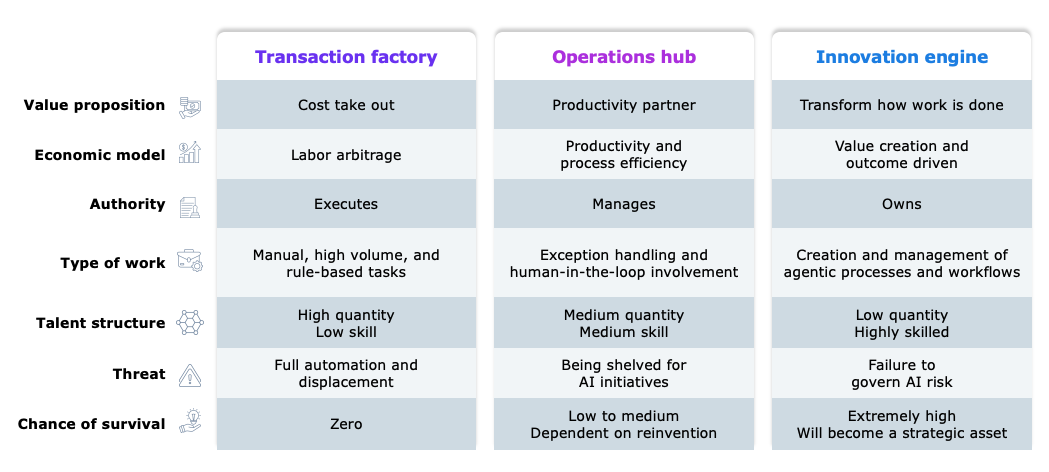
We’re already seeing real world example of Innovation Engines. At a recent HFS Roundtable, one insurance GCC leader told us how they are leveraging AI across their underwriting and claims processes to drive loss ratio improvements, enhancing claims velocity, and reducing cost-to-service. That’s how you pivot from back-office support to a core strategic center.
The value model your GCC is built on has (let’s face it) collapsed
We’ve lived through Shared Services models that were built around standardization and labor arbitrage and Global Business Services that expanded scale, scope, and integration across the enterprise. Both models assumed one constant: large numbers of people performing repeatable work, just organized more efficiently.
But agentic AI is pushing enterprises into a new era of value creation. Value isn’t created by scale or efficiency anymore. It’s enabled by AI’s ability to drive growth, differentiation, and competitive advantage without the need to keep adding labor costs. These are all things your GCC probably doesn’t do today, and it must become an innovation engine with AI at the core if it hopes to survive.
So where does your GCC sit?
Most GCC leaders instinctively believe their center sits somewhere between an Operations Hub and an Innovation Engine, but it’s very rare that instinct is right.
You might have a strong narrative and aspirations to embed AI at the core of your operations, but the harsh reality is that boards aren’t measuring GCC success by intent. They care about ownership. They care about governance. Most importantly, they care about outcomes. Today, most GCCs still deliver tasks such as app maintenance, tier-1 support, and repeatable analytics.
That’s why we have developed our GCC Temperature Check. A set of questions GCC leaders should ask themselves to cut through the hype and drop optimism for a dose of reality. It’s important leaders answer the following set of questions based on where they are today, rather than where they hope to be in a year:
The HFS GCC Temperature Check
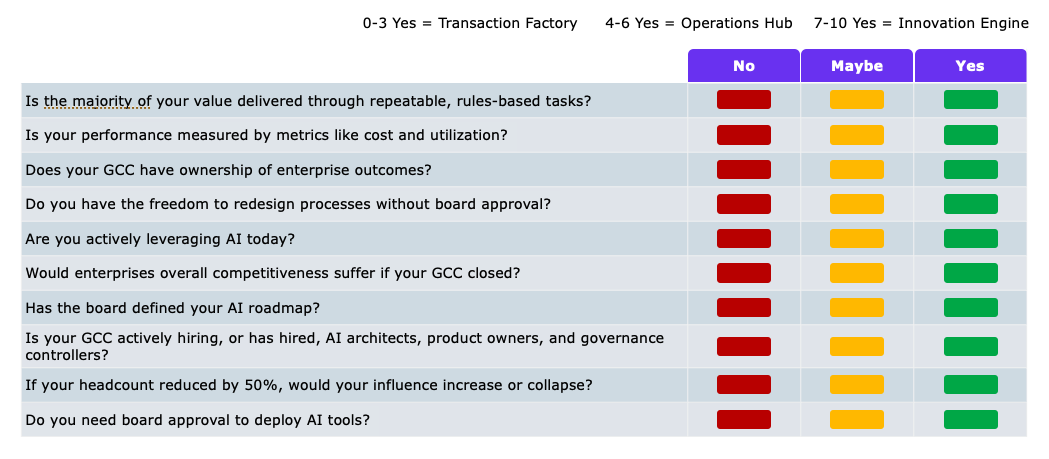
You’re not alone if you found yourself answering no to the majority of those questions. But it means you’re running a transaction factory, and your GCC will likely cease to exist in the next 18 months. Acting quickly is your only hope.
You have months, not years, to transform from transaction factory to innovation engine.
The window is closing faster than most GCC leaders realize. Early movers are already pivoting, reskilling their talent into agent development, orchestration, and complex problem-solving. They’re proactively cannibalizing their own transactional work before the board does it for them. They’re rebuilding their value proposition around AI transformation, product innovation, and measurable business impact beyond cost savings.
The laggards are hoping headquarters won’t notice, won’t do the math, won’t act. They’re clinging to current operating models while automation ROI becomes impossible to ignore. They face accelerating headcount reductions, budget cuts, and eventual closure.
But transforming into an innovation hub is no easy task, and can fail if executed poorly. We suggest GCC leaders take this approach:
- Immediately: Redefine success: Headcount and cost-saving metrics are outdated. Pivot to alternatives that demonstrate how your GCC created a competitive advantage with AI.
- Within 90 Days: Identify and canniablize transactional work: Automate every high-volume repetitive task possible, even if it means reducing headcount.
- Within 6 Months: Take ownership of AI deployment: Start building, deploying, managing, and governing elements of the enterprises AI infrastructure with limited oversight from the enterprise.
- Within 9 Months: Redesign the workforce: Transition administrative roles into new areas of the business and bring in a smaller number AI fluent employees.
- Within 12 Months: Demonstrate success: Prove the model works with hard data to justify continued investment.
This one year roadmap leaves GCC leaders six months to demonstrate continued success to the board before the 18 month timer runs to zero. That is the only way they can avoid evaporation.
Bottom Line: GCC Leaders don’t have time to wait for permission and must start the pivot to an innovation engine today
The GCCs that survive will move faster than headquarters bureaucracy typically allows, take calculated risks on emerging technologies, and build cultures of experimentation that attract world-class talent. It requires a complete reinvention, and the 18-month window to act is closing fast.
Our GCC Temperature Check is a stark reality check for most GCC leaders. Enterprise leaders will question why they’re maintaining expensive transaction factories that deliver work that agents execute more effectively. Once that question gets asked in the boardroom, your GCC has already lost.
Posted in : Agentic AI, AGI, GCCs